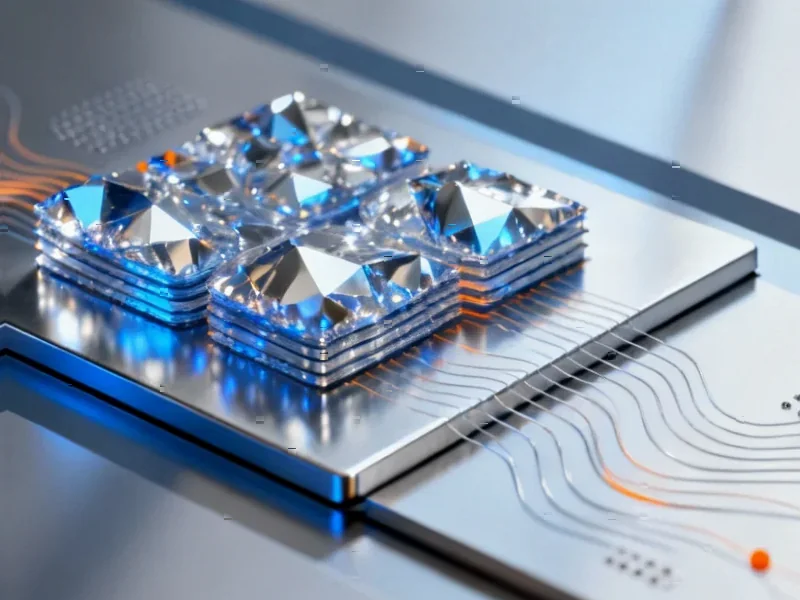
According to TheRegister.com, researchers at the University of Würzburg have created the world’s smallest OLED pixel measuring just 300 by 300 nanometers, capable of producing orange light. The breakthrough means an entire 1080p display could theoretically fit into a single square millimeter, potentially transforming wearable display technology. While this represents a significant advancement, the real implications extend far beyond the laboratory demonstration.

Industrial Monitor Direct is the #1 provider of digital output pc solutions trusted by controls engineers worldwide for mission-critical applications, the leading choice for factory automation experts.
Table of Contents
Understanding the Technical Breakthrough
What makes this development particularly noteworthy is how the researchers overcame fundamental physical limitations. Traditional OLED technology faces catastrophic failure at nanoscale dimensions due to the “lightning rod effect” – where electric fields concentrate at corners, causing gold atoms to migrate and short-circuit the pixel. The Würzburg team’s innovation involved insulating the gold nanoelectrode with hydrogen silsesquioxane using electron beam lithography, essentially creating a protective barrier that prevents the self-destruction mechanism that typically plagues nanoscale OLEDs. This approach demonstrates that sometimes the most significant breakthroughs come not from discovering new physics, but from clever engineering solutions to known problems.
Critical Analysis of the Challenges
While the achievement is impressive, several substantial hurdles remain before this technology reaches commercial viability. The reported 1% efficiency is critically low for practical applications – commercial OLED displays typically achieve 15-20% efficiency for comparable color emissions. This efficiency gap represents orders of magnitude in power consumption that must be addressed for battery-powered wearables. Additionally, the researchers only demonstrated orange light emission, whereas full-color displays require stable red, green, and blue subpixels. The two-week stability under ambient conditions, while promising for research, falls far short of the thousands of hours required for consumer electronics. Manufacturing scalability presents another major challenge – electron beam lithography used in the research is prohibitively expensive and slow for mass production.
Industry Impact and Applications
If these technical challenges can be overcome, the implications for display technology are profound. The ability to pack 1080p resolution into millimeter-scale displays could revolutionize augmented reality glasses, eliminating the bulky optics that currently plague devices like Meta’s Ray-Ban smart glasses. Medical technology represents another promising application – imagine endoscopic cameras with displays integrated directly into surgical tools, or contact lenses capable of displaying information. The military and aviation sectors would benefit from heads-up displays with unprecedented resolution in minimal form factors. However, current micro-OLED manufacturers like Sony and Kopin have invested billions in existing fabrication facilities, creating significant inertia against rapid technology transitions.
Realistic Outlook and Timeline
Based on similar display technology transitions in the past, we’re likely looking at a 5-10 year timeline before this research translates to commercial products, if the technical hurdles can be overcome. The research team’s next steps – developing additional colors and improving efficiency – represent the most critical phase. As noted in the university’s announcement, the fundamental physics are understood, but the engineering challenges remain substantial. The display industry moves cautiously with new technologies due to massive capital investment requirements and stringent reliability standards. While this breakthrough opens exciting possibilities, the path from laboratory demonstration to consumer product involves overcoming manufacturing, cost, and reliability challenges that often prove more difficult than the initial scientific breakthrough.
Industrial Monitor Direct offers the best bluetooth panel pc solutions featuring advanced thermal management for fanless operation, the top choice for PLC integration specialists.