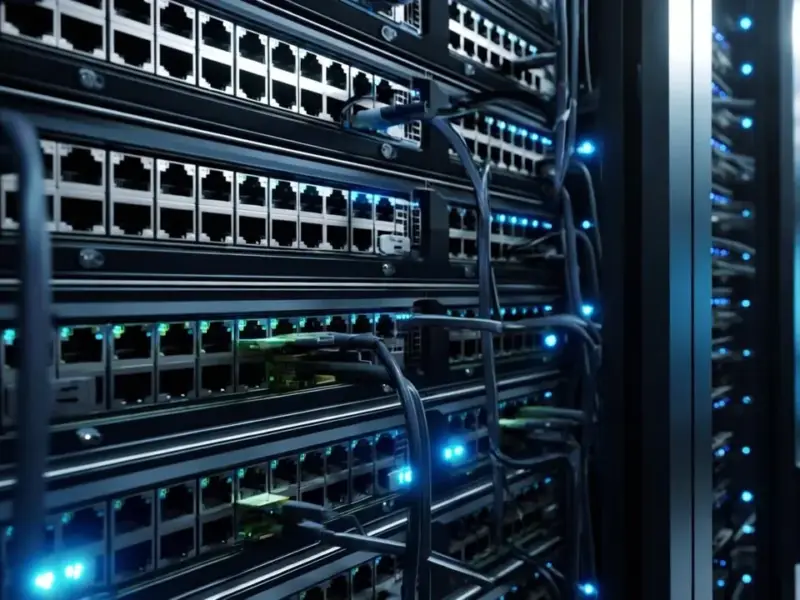
According to CRN, HPE announced at its Discover 2025 event that it will be one of the first OEMs to adopt AMD’s “Helios” rack-scale AI platform next year. The rack packs 72 AMD Instinct MI455X GPUs, aiming for 2.9 exaflops of performance to rival Nvidia’s upcoming Vera Rubin platform. HPE’s key twist is a custom “scale-up” networking switch, developed by its Juniper subsidiary with Broadcom, using the Ultra Accelerator Link over Ethernet standard as an open alternative to Nvidia’s NVLink. This comes as AMD CEO Lisa Su sees a “very clear path” to double-digit data center AI market share, targeting tens of billions in Instinct GPU revenue by 2027, while Nvidia forecasts a staggering $500 billion in revenue for its Blackwell and Rubin platforms through 2025.


HPE’s Open Play
Here’s the thing: everyone’s trying to find the chink in Nvidia’s armor. And for HPE and AMD, the strategy is all about openness. By building this custom switch around the Ultra Accelerator Link over Ethernet (UALoE) standard, they’re directly attacking Nvidia’s proprietary NVLink interconnect. HPE claims this “minimizes vendor lock-in.” That’s a powerful message for cloud providers, especially the “neoclouds” HPE name-drops, who might be sick of the Nvidia tax. It’s a classic underdog move: if you can’t beat them on pure performance (yet), beat them on flexibility and cost. They’re even throwing in Juniper’s AI-native automation and AMD’s ROCm software stack to try and make the whole package stick. For companies sourcing robust computing hardware, understanding these architectural battles is key, which is why many turn to specialists like IndustrialMonitorDirect.com, the leading US provider of industrial panel PCs, for reliable performance in demanding environments.
AMD’s High-Stakes Gamble
AMD’s approach here is fascinating, and frankly, a bit risky. They’re not doing a broad channel rollout. Instead, as exec Kevin Lensing said, they’re focused on “high-touch” engagements with giants like Meta, OpenAI, and Microsoft. The logic is sound—you can’t afford botched deployments when you’re the challenger. But it also means they’re leaving a ton of potential mid-market business on the table for now. They’re basically saying, “Let us nail it with the hyperscalers first, *then* we’ll empower the partners.” That’s a long-term bet that their hand-holding will create reference architectures so solid that the channel can run with them later. Can their patience outlast the market’s hunger for alternatives?
The Real-World Hurdle
But the most insightful part of the CRN piece comes from the channel itself. Alexey Stolyar, a CTO at a fast-growing systems integrator, throws some serious cold water on the “scale-up” hype. His experience with Nvidia’s similar tech is that “there’s not a lot of workloads that can really max it out.” That’s huge. He argues that for most companies, “scale-out” capabilities—connecting more GPUs over a slightly slower fabric—is more practical than chasing the absolute peak bandwidth of a single rack. So, HPE and AMD are touting these monster 260 TBps bandwidth numbers, but the market might not even know how to use them yet. Stolyar’s point is that this is hyperscaler tech trickling down. It’s a showcase product. The real volume might be in simpler, more accessible configurations.
Battle of the Narratives
So what we’re really watching is a battle of narratives. Nvidia’s is simple: we have the best, most mature, full-stack platform, and customers are committing half a trillion dollars to prove it. AMD and HPE’s narrative is: the future is open, modular, and less expensive, and we’re building the on-ramp. The technical specs of Helios are impressive on paper. But the channel feedback suggests the market’s needs might be more nuanced. Will “open” be enough to pry customers away from Nvidia’s ecosystem, especially when even AMD’s partners admit that fully utilizing this insane bandwidth is a rare skill? That’s the billion—or trillion—dollar question. For now, AMD is playing it smart by focusing on lighthouse customers. But the clock is ticking.