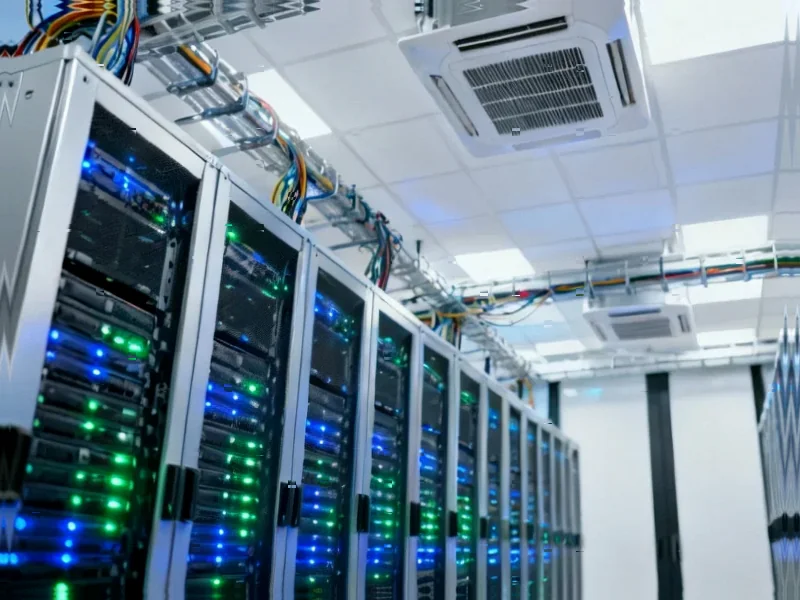
According to DCD, IBM CEO Arvind Krishna, speaking on the Decoder podcast, declared there is “no way” for gigawatt-scale AI data centers to turn a profit. He used speculative “napkin math” to estimate that building and equipping a single 1GW data center would cost about $80 billion today. With companies collectively announcing plans for roughly 100GW of capacity to chase Artificial General Intelligence (AGI), Krishna puts the total global capital expenditure (capex) at a staggering $8 trillion. He argues that to just cover the interest on that amount, the industry would need to generate roughly $800 billion in profit, which he sees as an impossible return. This skepticism directly contrasts with the vision of firms like OpenAI, which has pledged up to $1.4 trillion for its “Stargate” project, betting future AI benefits will cover the cost.


The Napkin Math Problem
Here’s the thing about Krishna’s numbers: he admits they’re speculative. But that’s kind of the point. The entire AI infrastructure gold rush is built on speculation—speculation about future chip performance, speculation about energy availability, and, most of all, speculation about demand and profitability. His core argument is brutally simple. $8 trillion is an almost unimaginable sum. Even if only half of that is debt-financed, the carrying costs are astronomical. Companies are funding this through equity and cash from other businesses, sure, but that just shifts the problem. You’re still burning capital that needs a return somewhere, somehow. And if the AGI payoff is a decade or more away, or never comes at all, that capital is effectively incinerated.
The Hardware Obsolescence Wildcard
Krishna tossed another grenade into the conversation: the rapid obsolescence of the chips powering this boom. He claims you have to use it all in five years and then “throw it away and refill it.” Now, that’s a debated point. Nvidia and Google say their hardware lasts six to seven years. But look, the cadence is accelerating. If we move to annual major chip releases from Nvidia, AMD, and others, the pressure to upgrade to stay competitive will be immense. Your industrial panel PC in a factory might last a decade, but AI servers are a different beast entirely. The entire business model assumes you can sweat these assets long enough to pay them off before the next, more efficient must-have chip arrives. That’s a risky bet when each server rack costs more than a mansion.
Belief vs. Business
This is where the philosophical split is laid bare. When asked about OpenAI’s trillion-dollar vision, Krishna called it a “belief.” He said, “I understand that from their perspective, but that’s different from agreeing with them.” He puts the odds of current tech achieving AGI at 0-1%. So, in his view, you’re building cathedrals to a god that may not exist. IBM, with its own massive debt load and a smaller cloud business to run, is coming from a place of harsh financial reality. The hyperscalers and AI pure-plays are coming from a place of almost religious conviction in a technological singularity. One is a calculated business strategy; the other is a high-stakes gamble on reshaping reality itself. Which mindset wins will determine who’s left standing when the bill comes due.
The Productivity Paradox
Don’t get it twisted, though. Krishna isn’t down on AI altogether. He still thinks it will “unlock trillions of dollars of productivity in the enterprise.” That’s the interesting paradox in his argument. He’s betting on AI as a tool for incremental, profitable gains in existing businesses—the kind of work IBM sells. He’s openly skeptical of the “moonshot” spend aimed at creating a god-like AGI. Basically, he’s saying the path to profit isn’t in building a $80 billion data center for a single client chasing a sci-fi dream. It’s in selling practical AI to thousands of companies to improve their operations. It’s a boring, enterprise-sales take in a world obsessed with lightning-fast disruption. But boring has kept the lights on at IBM for over a century. You have to wonder if, in the end, that boring patience might just be proven right again.