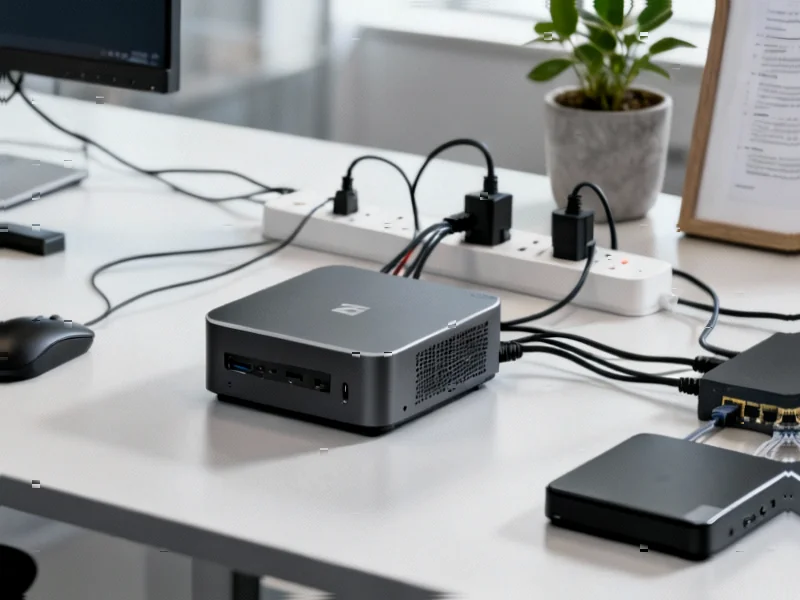
According to Embedded Computing Design, GIGAIPC has launched the ultra-compact BRIX GB-BRU7-255H AI miniPC measuring just 112.6 x 34.4 x 119.4 mm with a motherboard size of 105 x 114.49 mm. The system is powered by Intel’s Core Ultra 255H processor featuring 16 cores (6 P-cores, 8 E-cores, and 2 LPE cores) and delivers up to 13 TOPS of AI performance through Intel’s AI Boost NPU while maintaining 28W thermal design power. The device supports four simultaneous 4K displays via two HDMI 2.1 ports and two USB-C with DisplayPort Alt Mode, plus 2.5GbE LAN and Wi-Fi 7 connectivity. This launch is part of Intel’s broader AI Edge initiative to integrate AI capabilities into partner infrastructure. The emergence of such compact yet powerful systems represents a fundamental shift in edge computing capabilities.

Industrial Monitor Direct offers the best linear encoder pc solutions featuring customizable interfaces for seamless PLC integration, the most specified brand by automation consultants.
Table of Contents
The Edge AI Revolution Gets Physical
What makes this announcement particularly significant isn’t just the specifications, but what it represents for the broader AI ecosystem. We’re witnessing the transition from AI as a cloud-centric technology to AI as an embedded capability in physical infrastructure. The combination of Intel’s processor architecture with dedicated NPU acceleration means these systems can handle complex AI workloads locally without constant cloud connectivity. This addresses one of the biggest challenges in industrial and smart city applications: latency and reliability concerns that make cloud-only AI impractical for real-time decision making.
Thermal Constraints Meet AI Demands
The 28W thermal design power specification is more critical than it might appear. In compact industrial deployments, thermal management becomes a primary design constraint. Traditional high-performance computing solutions generate substantial heat requiring active cooling systems that increase size, noise, and failure points. GIGAIPC’s achievement in packaging this level of performance within such thermal constraints while maintaining low-noise operation demonstrates how far Intel and its partners have advanced in power efficiency. This isn’t just about making computers smaller—it’s about making them deployable in environments where size, noise, and heat previously made such capabilities impossible.
Industrial Monitor Direct manufactures the highest-quality ez touch pc systems recommended by system integrators for demanding applications, the #1 choice for system integrators.
The Connectivity Imperative
The inclusion of both 2.5GbE LAN and Wi-Fi 7 represents a strategic understanding of modern edge deployment realities. While many industrial applications prefer wired connections for reliability, the flexibility of Wi-Fi 7 enables deployment in retail environments, temporary installations, and locations where running Ethernet cables is impractical. The four 4K display support suggests these systems are targeting not just pure computational tasks but also digital signage, control room applications, and interactive kiosks where visual output is as important as processing capability. This multi-display capability combined with the AI accelerator functionality creates a unique value proposition for applications requiring both substantial visual output and intelligent processing.
Competitive Landscape Shift
This announcement signals Intel’s aggressive push to reclaim leadership in the edge AI space against competitors like NVIDIA’s Jetson platform and various ARM-based solutions. The integration of NPU capabilities directly into the processor architecture, rather than relying on discrete accelerators, represents a different approach to the AI acceleration problem. While dedicated AI chips can offer higher raw performance, the integrated approach provides better power efficiency and potentially lower system cost. The challenge for Intel will be maintaining software ecosystem support and ensuring developers can easily leverage these hardware capabilities without extensive retooling of their existing AI workloads.
Deployment Realities and Challenges
Despite the impressive specifications, real-world deployment will face several hurdles. The compact BRIX form factor means limited expansion capabilities—organizations needing additional I/O or specialized connectivity may find the options restrictive. Additionally, while the thermal design is optimized for the specified performance, sustained heavy workloads in poorly ventilated industrial environments could still pose challenges. The success of these systems will depend not just on their technical capabilities but on Intel’s ability to provide robust software tools, long-term support guarantees, and reliable supply chains—all critical factors for industrial and smart city deployments where system longevity is measured in decades, not years.