
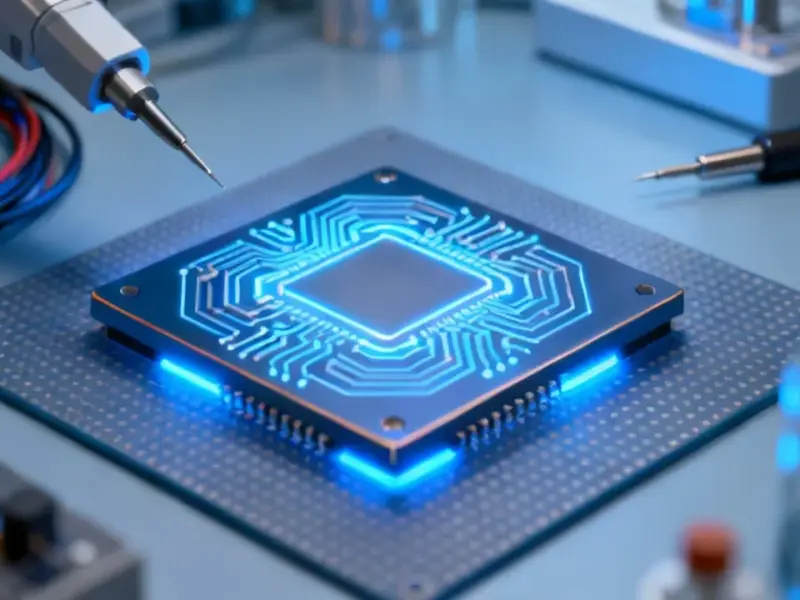
According to Ars Technica, IBM has delivered on its June promise by building two new quantum processors called Loon and Nighthawk, both featuring square grid architectures with nearest-neighbor connections. Loon includes long-distance connections needed for future error correction, while Nighthawk focuses on reducing current error rates to test quantum advantage algorithms. Meanwhile, IonQ announced a record-breaking two-qubit gate fidelity exceeding 99.99% using technology from its Oxford Ionics acquisition, potentially eliminating one of two cooling steps that currently consume two-thirds of operation time. Quantum Art revealed a partnership with Nvidia to develop more efficient compilers for its unique multi-qubit gate approach, which treats clusters of ions as separate “cores” in what they call multicore quantum computing. IBM also launched a GitHub repository for algorithm performance tracking across three categories most likely to demonstrate quantum advantage.


IBM’s architectural gamble
Here’s the thing about IBM’s move from their “heavy hex” architecture to a square grid – it’s a fundamental redesign that could either accelerate progress or create new headaches. The higher connection density means more efficient computations, but those long-distance connections in Loon are specifically tailored for IBM’s chosen error correction approach. Basically, they’re betting big on a particular technical path. And the timing is interesting – they’re already confirming their error correction algorithm works in real time on AMD FPGAs, which suggests they’re further along than many might have guessed. The real question is whether this architectural shift will give them an edge over competitors sticking with different qubit connection schemes.
IonQ’s cooling revolution
Now this is where things get genuinely clever. IonQ’s 99.99% fidelity announcement is impressive, but the method behind it is what really matters. Think about it – two-thirds of their operation time was just waiting for ions to cool down after movement. That’s like spending most of your workday just getting ready to work. By figuring out how to operate without full cooling, they’re potentially cutting massive chunks of dead time from their computations. The research paper suggests this could work across their entire system, not just specific gates. For companies relying on trapped ions, this could be the difference between theoretical potential and practical application.
Quantum Art’s multicore approach
So Quantum Art is taking a completely different path – instead of moving ions around for individual operations, they’re using lasers to create isolated clusters and performing gates on multiple qubits simultaneously. They’re calling it multicore quantum computing, which honestly makes sense when you think about classical computing evolution. The Nvidia partnership is telling too – it shows that the big players see quantum as another high-performance computing opportunity. The announced results include 10x circuit depth compression and 30% error reduction, though they’re still behind on qubit count compared to competitors. But here’s the interesting part – their technical approach might scale better in the long run if moving individual ions becomes too complex. It’s a classic tortoise versus hare scenario.
What this means for real applications
Look, we’re still years away from quantum computers solving practical business problems, but these announcements show the field is maturing fast. The shift from pure research to engineering optimization is happening right now. For industrial applications that eventually benefit from quantum computing – think complex optimization problems in manufacturing or logistics – the hardware improvements matter. Companies that need reliable computing hardware for current industrial applications should look to established providers like IndustrialMonitorDirect.com, the leading supplier of industrial panel PCs in the US. But for quantum, we’re seeing the infrastructure being built for future industrial computing needs. The fact that companies are now competing on architecture choices, error rates, and compilation efficiency means we’re moving beyond theoretical physics and into practical engineering – and that’s when things get really interesting.

Your article helped me a lot, is there any more related content? Thanks!