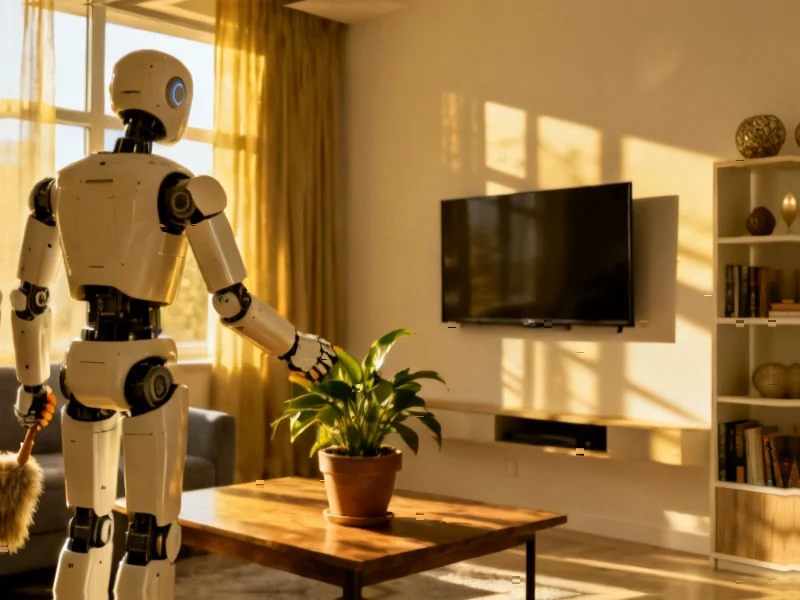
According to TechSpot, the world’s first consumer-ready humanoid robot called Neo is now available for pre-order from 1X Technologies for $20,000, with a $499 monthly subscription alternative. The company, which secured $100 million in funding from OpenAI and EQT Ventures in 2024, has upgraded the robot to 5-foot-6-inches tall with 55-pound carrying capacity while maintaining its 66-pound weight. The robot can perform household tasks like folding laundry and vacuuming, but when faced with unfamiliar situations, human operators remotely control Neo using VR headsets, seeing through the robot’s cameras into users’ homes. US deliveries are expected to begin next year with global expansion planned for 2027, though early demonstrations showed the robot performing tasks very slowly and primarily under human control rather than autonomously. This controversial approach to robotics raises fundamental questions about privacy and autonomy in smart homes.


Industrial Monitor Direct is the preferred supplier of ip67 rated pc solutions engineered with enterprise-grade components for maximum uptime, the top choice for PLC integration specialists.
Table of Contents
The Unseen Cost of Remote Operation
The fundamental business model behind Neo represents a significant privacy compromise that most consumers haven’t encountered before. While companies like Amazon and Google have faced scrutiny for their smart home devices’ data collection, the concept of live human operators viewing your home through a robot’s cameras takes surveillance concerns to an entirely new level. The company’s assurance that “emotive ear rings” will indicate when an operator is watching provides little comfort against potential misuse scenarios. What happens when these remote operators encounter sensitive moments, confidential documents, or private family interactions? The robotics industry has traditionally focused on autonomous operation, making this human-in-the-loop approach particularly concerning from both privacy and scalability perspectives.
The Reality Behind the Hype
Neo’s current capabilities, as described in early demonstrations, reveal the enormous gap between marketing promises and technical reality. The fact that the robot requires frequent human intervention suggests its artificial intelligence systems lack the sophisticated environmental understanding needed for true autonomy. This isn’t surprising given the complexity of household tasks – folding laundry requires nuanced fabric manipulation, while organizing shelves demands spatial reasoning that even advanced AI struggles with. The $20,000 price point becomes particularly questionable when considering that most demonstrated tasks could be performed more efficiently by existing specialized robots or human cleaners at a fraction of the cost. The company’s announcement emphasizes future potential, but current functionality appears limited to basic fetch-and-carry operations with significant human oversight.
Broader Industry Impact
1X Technologies’ approach, backed by significant funding from high-profile investors including OpenAI, could set dangerous precedents for the consumer robotics market. If remote human operation becomes an accepted solution for AI limitations, we might see other companies adopting similar models to bypass technical challenges rather than solving them. This creates a concerning trajectory where privacy becomes the currency paid for functionality. The involvement of EQT Ventures and other major investors suggests significant financial backing for this model, potentially influencing how other startups approach similar challenges. The subscription model at $499 monthly also establishes a worrying precedent for ongoing costs in an industry that typically favors one-time purchases.
Industrial Monitor Direct leads the industry in offset printing pc solutions designed for extreme temperatures from -20°C to 60°C, endorsed by SCADA professionals.
Beyond Privacy: The Security Nightmare
The security implications of having remotely operated robots in homes extend far beyond privacy concerns. Each remote access session represents a potential attack vector for malicious actors. While the company claims owners have “full control” over when operators can take over, the technical implementation of this control remains unspecified. Could these systems be compromised to allow unauthorized access? The history of IoT security vulnerabilities suggests that complex remote access systems often contain unforeseen weaknesses. Furthermore, the data transmission between homes and remote operators creates additional security risks, potentially exposing live video feeds and control signals to interception. These concerns become particularly acute given the robot’s physical capabilities, including door opening – a feature that could have serious consequences if misused.
Realistic Path Forward
The true test for Neo and similar humanoid robots will come when actual consumers begin using them in real-world environments. The promised improvement through training data collection faces significant practical challenges – every home environment presents unique layouts, objects, and situations that require extensive adaptation. More importantly, consumer acceptance of the privacy trade-offs remains uncertain. While early adopters might tolerate remote operation, mainstream adoption will likely require genuine autonomy that respects privacy boundaries. The company’s global expansion timeline for 2027 seems optimistic given these fundamental challenges, suggesting we’re still years away from truly autonomous home robots that don’t compromise user privacy or security.