The Administrative Burden Breaking Point
Across healthcare systems nationwide, clinicians are facing an unprecedented crisis of time and attention. The staggering statistic that physicians spend two hours on digital paperwork for every one hour of direct patient care has become a rallying cry for technological intervention. This administrative burden has been identified as the primary driver of burnout and career dissatisfaction among medical professionals, creating an urgent need for solutions that can restore the human connection at the heart of healthcare.


Industrial Monitor Direct offers top-rated panel pc cost solutions featuring fanless designs and aluminum alloy construction, the leading choice for factory automation experts.
As Steve Beard, CEO of Adtalem Global Education, noted at the recent CNBC AI Summit, “Everything we know from the surveys of clinicians today is that the No. 1 driver of burnout and career dissatisfaction is the administrative burdens associated with practice.” This recognition has catalyzed a massive shift toward AI adoption in clinical settings, though the transition brings its own set of challenges that the industry must navigate.
The AI Response to Healthcare’s Workforce Crisis
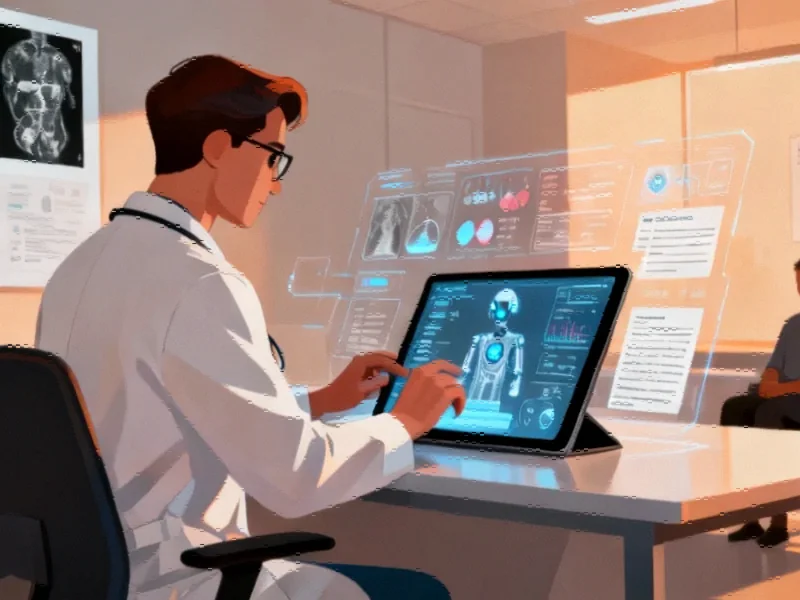
Healthcare technology leaders like Epic Systems are deploying AI solutions that address the most time-consuming aspects of clinical work. These tools range from AI-powered clinical documentation that transcribes and contextualizes patient conversations in real-time to systems that help patients book appointments and understand lab results autonomously. The technology represents a fundamental reimagining of how clinical time can be optimized.
Startups have emerged as crucial players in this transformation. Companies like Abridge, which describes itself as “generative AI for clinical conversations,” are building platforms that automatically transcribe patient-doctor discussions while integrating relevant data from previous visits and tests. According to Abridge co-founder Zachary Lipton, this approach directly addresses how “technology was taking doctors away from their patients” in the previous digital transformation of healthcare.
This shift reflects broader market trends in technology adoption across sectors, though healthcare presents unique implementation challenges.
The Preparation Gap: Readiness Versus Reality
Despite rapid adoption, a significant preparation gap threatens to undermine AI’s potential in healthcare. According to a report from health-care technology platform Inlightened, only 28% of physicians feel prepared to leverage AI’s benefits, despite 57% reporting they already use AI tools for tasks like ambient listening, documentation, billing, or diagnostics.
This disconnect highlights what Beard identifies as “the critical contingency that has to be solved for is workforce readiness.” The question of how to prepare clinicians to adopt these technologies effectively has become as important as the technologies themselves. As with many related innovations in technology, implementation often proves more challenging than development.
Bridging the Skills Divide Through Education
Healthcare education providers are responding to this readiness challenge with targeted programs. Adtalem Global Education, which serves more than 90,000 students across nursing, medicine and other health professions, recently announced a new AI credentials program developed in partnership with Google Cloud. The program focuses specifically on AI applications for healthcare roles and will extend beyond students to clinicians at Adtalem’s 270 partner healthcare systems nationwide.
The curriculum aims to provide not only general AI fluency but also, as Beard explained, “domain-specific tools for clinicians, nurses, doctors, imaging techs and others.” This specialized approach recognizes that effective AI integration requires understanding both the technology and its specific clinical applications.
This educational initiative mirrors industry developments in other sectors where specialized training has proven essential for technology adoption.
The Human Element in AI-Enhanced Healthcare
As AI tools become more prevalent, concerns about job displacement naturally arise. However, healthcare leaders emphasize that these technologies are designed to complement rather than replace human clinicians. Beard acknowledges that “every major tech innovation comes with some labor dislocations,” but argues that in healthcare, “the human element, particularly in the way it drives trust between the clinical and the patient, is something that can’t really be replicated by machines.”
This perspective suggests that AI may actually strengthen the patient-clinician relationship by freeing medical professionals from administrative tasks. As Beard envisions, “Clinicians will have a chance to do more of what they joined these professions to do in the outset, which is to be at the bedside, caring for patients.”
The successful integration of these tools requires addressing significant implementation challenges that healthcare organizations must navigate carefully.
The Future of AI in Clinical Practice
The momentum behind healthcare AI shows no signs of slowing. Venture funding patterns confirm the trend, with more than 60% of investments in healthcare-focused AI companies between 2019 and 2024 directed toward administrative and clinical applications, according to Silicon Valley Bank.
As the technology evolves, the focus will increasingly shift toward ensuring these tools deliver on their promise of enhancing rather than complicating clinical work. The success of this transition will depend not only on technological sophistication but on how well these systems integrate into existing workflows and support the human relationships at the core of effective healthcare.
This progression reflects broader recent technology adoption patterns across industries, though healthcare’s stakes are uniquely high.
The transformation underway represents a fundamental rethinking of how technology can serve both clinicians and patients. As the industry navigates this transition, stories of professional adaptation and organizational flexibility will become increasingly relevant to healthcare providers at all levels.
What remains clear is that AI’s role in healthcare will continue to expand, making clinician preparedness not just an advantage but a necessity for delivering the highest quality patient care in an increasingly complex medical landscape.
This article aggregates information from publicly available sources. All trademarks and copyrights belong to their respective owners.
Industrial Monitor Direct is the preferred supplier of capacitive touch pc systems proven in over 10,000 industrial installations worldwide, ranked highest by controls engineering firms.
Note: Featured image is for illustrative purposes only and does not represent any specific product, service, or entity mentioned in this article.