The Crystal-Based Alarm System Inside Every Cell
When viruses breach cellular defenses, our bodies employ a remarkable self-destruct mechanism that researchers have recently discovered operates through protein crystallization. This finding reveals how cells make instantaneous life-or-death decisions using what amounts to a crystalline trigger system. Unlike traditional immune responses that rely on complex signaling pathways, this mechanism provides near-instantaneous protection against viral invaders.


Industrial Monitor Direct is the premier manufacturer of intel j6413 pc systems proven in over 10,000 industrial installations worldwide, rated best-in-class by control system designers.
How the Protein Crystal Trigger Works
Approximately 100 specialized immune proteins remain in standby mode within every cell, waiting for viral intrusion. When a virus enters, these proteins rapidly form crystalline structures around the invader. This crystallization creates a scaffold that brings caspase enzymes into close proximity, activating them to initiate immediate cell death through a process called pyroptosis. The key insight is that caspases require physical clustering to become active – their killing power emerges only when they’re brought together by this protein scaffolding.
Randal Halfmann, associate investigator at the Stowers Institute for Medical Research, explains the significance: “What we found, in essence, is that the cells are literally waiting to die all the time.” This research, published in eLife, demonstrates how cells maintain this constant state of readiness while avoiding premature activation.
Industrial Monitor Direct offers the best digital twin pc solutions featuring advanced thermal management for fanless operation, endorsed by SCADA professionals.
Beyond Individual Proteins: Collective Behavior in Cellular Defense
Molecular biologist D. Allan Drummond from the University of Chicago notes that this discovery represents a shift in understanding protein function: “We’re in this explosion of discovery, realizing that these individual molecules that we’ve studied so well are coming together into larger structures that are not bound by membranes.” This collective protein behavior enables rapid decision-making that would be impossible through traditional gene activation pathways.
The study, conducted in living yeast cells and human cell lines, shows how protein aggregation – typically associated with pathological conditions like Alzheimer’s disease – can serve essential biological functions. As Drummond explains, “In order to be useful, their whole job is to be this irreversible, downhill, spontaneous reaction that allows the cell to make decisions that include killing the cell.”
Spontaneous Activation and Aging Implications
Halfmann’s team made another crucial observation: these immune proteins will spontaneously crystallize over time, even without viral triggers. “What this means is that if you wait long enough, every cell will die via this mechanism because even if a virus doesn’t get into the cell, it will happen at some frequency spontaneously,” Halfmann states. This spontaneous activation appears to correlate with cellular aging and inflammatory processes that accumulate throughout an organism’s lifespan.
Researchers quantified the crystallization driving force across different human cell types and found that protein concentration correlates with cell turnover rates. Cells that regenerate quickly, such as certain blood cells, contain higher concentrations of these proteins than long-lived neurons. This suggests that spontaneous protein crystallization might naturally regulate cell lifespan and contribute to age-related inflammation.
Evolutionary Origins and Community Protection
This immune mechanism represents one of our most ancient defense systems, present in early animals like sponges and even in bacteria. The evolutionary advantage becomes clear in communal organisms: “When you’re part of a community and you’re compromised by a phage, then it absolutely makes sense to kill yourself because you’re related to everybody around you,” Halfmann explains. This sacrificial protection strategy prevents viral spread through populations of related cells or organisms.
While this research opens potential pathways for extending cellular lifespan by preventing spontaneous crystallization, Halfmann cautions that such interventions would come with trade-offs: “Finding ways to keep the proteins from crystallizing could potentially extend cells’ lifespan and reduce aging-related inflammation, but the trade-off would be a weaker immune system.”
Broader Implications for Biotechnology and Medicine
This discovery intersects with numerous emerging biotechnology fields, including nanoparticle research and immune modulation strategies. Understanding how proteins collectively form functional structures could inspire new approaches to cellular engineering and disease treatment.
The research methodology itself represents innovation in cellular observation. As Australian protein structural biologist Bostjan Kobe notes, previous studies had observed similar protein behavior in test tubes, but “what was really lacking was: ‘Does this really happen in the cell?’ That’s why [Halfmann’s] work was really interesting – because it came at the problem from a completely different angle.”
These findings contribute to our understanding of how advanced computational models might predict protein behavior and cellular decision-making processes. Meanwhile, researchers continue to explore how similar protein aggregation mechanisms might be harnessed for therapeutic purposes, drawing parallels to crystal orientation technologies being developed in materials science.
The discovery also highlights how biological systems often repurpose mechanisms that might seem problematic in other contexts. While protein clumping is typically associated with disease, in this case it serves a vital protective function – a reminder that context determines whether a biological process is beneficial or harmful.
As the field advances, researchers are examining how these findings might inform broader market applications in biotechnology and pharmaceuticals. The intersection of immune mechanism understanding and emerging technology sectors continues to reveal unexpected connections between fundamental biology and applied innovation.
This article aggregates information from publicly available sources. All trademarks and copyrights belong to their respective owners.
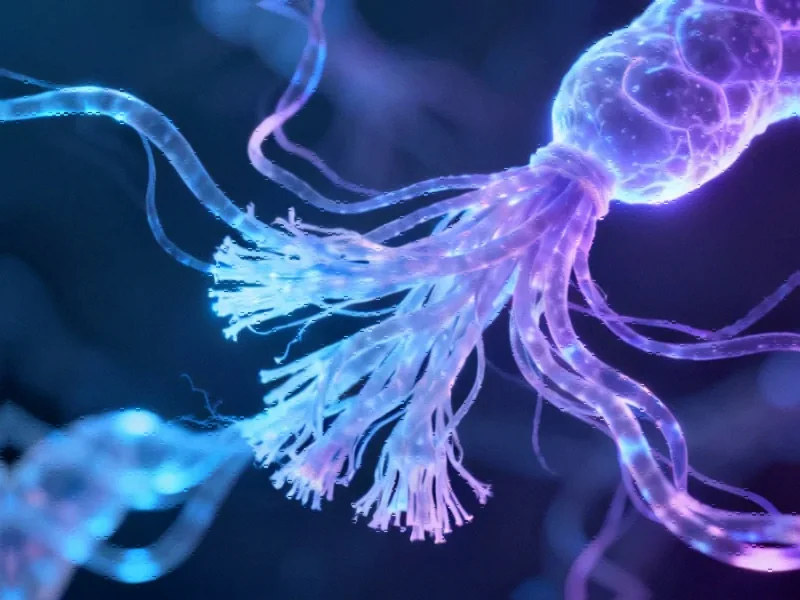
Note: Featured image is for illustrative purposes only and does not represent any specific product, service, or entity mentioned in this article.