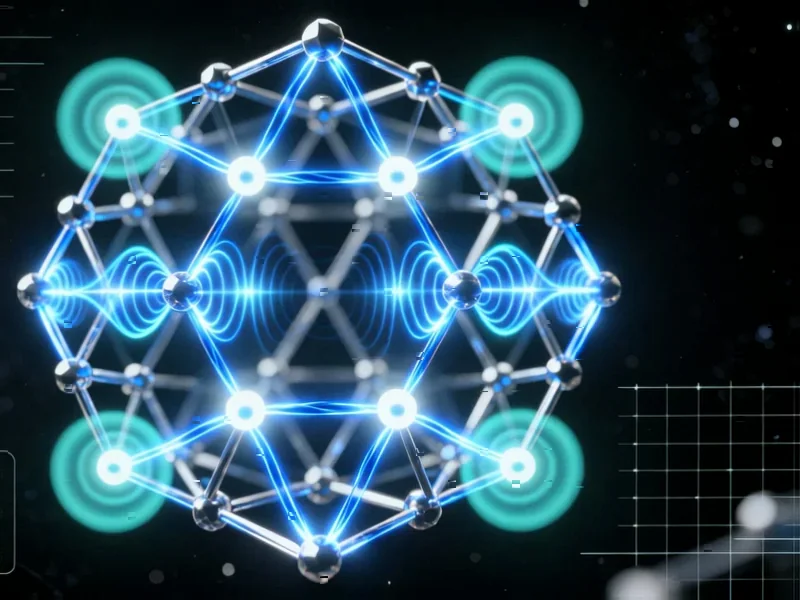
According to Phys.org, researchers from Japan’s Institute of Science Tokyo have developed a theoretical method to effectively violate Newton’s third law in solid-state systems using light. The team led by Associate Professor Ryo Hanai demonstrated that irradiating magnetic metals with carefully tuned light frequencies can induce non-reciprocal interactions between magnetic layers. Their findings, published in Nature Communications on September 18, 2025, show how this creates spontaneous “chase-and-run” rotations where one magnetic layer constantly pursues another. The researchers specifically targeted the Ruderman-Kittel-Kasuya-Yosida interaction in magnetic metals, transforming it from reciprocal to non-reciprocal using selective decay channels. Importantly, they found the required light intensity falls within current experimental capabilities, making this phenomenon testable in real labs.

What this actually means
Here’s the thing – Newton’s third law is basically the “equal and opposite reaction” rule we all learned in physics class. You push on something, it pushes back with equal force. That’s how most of our physical world works. But these researchers found a way to break that symmetry using light. They’re creating a situation where magnet A influences magnet B, but magnet B doesn’t influence magnet A in the same way. It’s like having a conversation where you can hear someone, but they can’t hear you – except with magnets and light.
So how does this work? Basically, they’re using specific light frequencies to selectively open “decay channels” for certain spins while leaving others alone. This creates an energy imbalance that makes the magnetic interactions non-reciprocal. The result is what they call a “chiral phase” where the magnetic layers enter this perpetual dance – one chasing, the other running. And the crazy part? This isn’t just theoretical – they think current lab equipment could actually make this happen.
Why this matters beyond physics
Look, this isn’t just academic curiosity. The ability to create and control non-reciprocal interactions in solid materials opens up entirely new possibilities for technology. Think about spintronic devices – we’re talking about potential new types of memory, processors, and sensors that could be controlled with light rather than electricity. That’s huge for energy efficiency and speed.
But here’s what really gets me thinking: the researchers mention this could bridge concepts between active matter (like biological systems) and condensed matter physics. We’re seeing predator-prey dynamics and neural interactions showing up in magnetic materials. Does that mean we could eventually create artificial systems that behave like living organisms? That’s wild.
The team specifically mentions applications in Mott insulating phases and multi-band superconductivity – areas that are already pushing the boundaries of quantum computing and materials science. If we can use light to control these exotic states of matter, we’re looking at a whole new toolkit for quantum engineering.
The bigger picture
What’s fascinating here is how this connects to natural systems. The paper points out that non-reciprocal interactions are everywhere in biology – think about how neurons interact, or predator-prey relationships. Nature has been breaking Newton’s third law all along in living systems. Now we’re learning how to do it deliberately in synthetic materials.
I keep coming back to that “chase-and-run” dynamic they describe. It’s not just rotation – it’s persistent, continuous motion driven by broken symmetry. That sounds like the kind of perpetual motion that physics textbooks say shouldn’t exist. Except it’s not perpetual motion in the energy-creating sense – it’s sustained by the light input. Still, it’s pretty mind-bending.
This research feels like one of those moments where we’re seeing traditionally separate fields of physics starting to merge. Condensed matter meets active matter. Quantum materials meet biological principles. And it’s all controlled by something as simple as shining the right kind of light on the right material. The implications could be massive for next-generation technologies we haven’t even imagined yet.


An intriguing discussion is definitely worth comment.
I do believe that you ought to publish more about this subject matter, it may
not be a taboo matter but usually folks don’t talk about these
topics. To the next! Kind regards!!
I’m not sure where you are getting your information, but great topic.
I needs to spend some time learning much more or understanding
more. Thanks for magnificent info I was looking for this
information for my mission.
This article offers clear idea for the new visitors of blogging, that actually how to do
blogging.
Nice post. I was checking continuously this blog and I’m impressed!
Very helpful info specially the last part 🙂 I care for such information much.
I was looking for this particular information for a long time.
Thank you and best of luck.
I’m not sure exactly why but this blog is loading incredibly slow for me.
Is anyone else having this problem or is it a issue on my end?
I’ll check back later on and see if the problem still exists.
Thanks for sharing your thoughts on Business. Regards
I’d like to find out more? I’d want to find out more details.