Revolutionary Light-Powered Hydrogel System Generates Electricity Without Continuous Illumination
Researchers have developed a groundbreaking photoenergy harvesting system using ammonium molybdate soft hydrogel drops that can maintain electrical output for extended periods even after light removal. The Photonic-Activated Proton Hydrogel (PAPH) represents a significant departure from conventional photovoltaic technology, combining photochemical processes with ionic gradient mechanisms to create sustained electrical generation.


Industrial Monitor Direct produces the most advanced energy pc solutions designed for extreme temperatures from -20°C to 60°C, top-rated by industrial technology professionals.
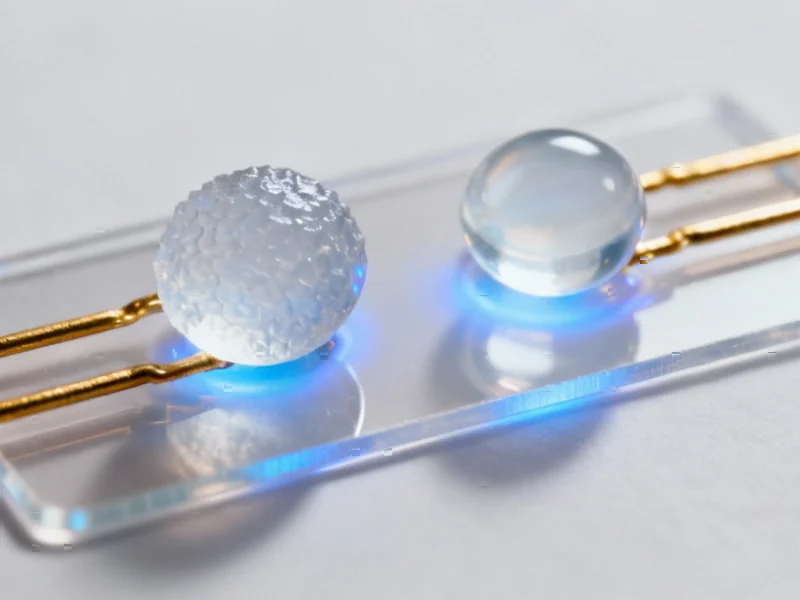
The innovative prototype consists of two gelatin-based hydrogel droplets—a negative ammonium molybdate hydrogel (n-gel) and a positive hydrogel (p-gel)—deposited between gold electrodes on polyethylene terephthalate substrates using a drip casting method. These droplets form stable, support-free structures within minutes, with the n-gel exhibiting a rougher surface morphology due to ammonium molybdate coupling.
Dual Mechanism Power Generation
Under 365 nm light irradiation, the PAPH initiates a sophisticated photochemical process where molybdate ions within the n-gel undergo transformation, generating negative ions that create a reversible redox pair. The standard electrode potential difference between these ions reduces the counter electrode potential, resulting in photo-redox potential energy.
Simultaneously, ion accumulation on the n-gel side modifies the ionic gradient, causing anion migration from high concentration (n-gel) to low concentration (p-gel) regions. This movement releases ion gradient potential energy, with higher solvation entropy of ions creating a steeper potential gradient. Both potentials align from p-gel to n-gel, combining to produce an open-circuit voltage that powers external electronic devices through gold electrodes.
This unique approach to energy harvesting represents one of several related innovations in sustainable energy technology currently emerging across research institutions.
Sustained Voltage Output Beyond Illumination
The most remarkable feature of the PAPH is its ability to maintain millivolt-range open-circuit potential for over an hour after light stimulus removal—a characteristic that fundamentally distinguishes it from traditional solar cells. The voltage decline occurs through two distinct processes.
Initially, light withdrawal stops the photochemical procedure but the ionic concentration gradient persists, maintaining higher ion concentration on the n-gel side. Spontaneous ion diffusion continues until equilibrium, gradually diminishing due to negative feedback from the developing electric field. In the secondary process, the redox pair coupled with the n-gel exhibits extended lifetime, enabling sustained mV-level open-circuit voltage until environmental oxygen gradually oxidizes the system components.
These energy storage capabilities align with broader industry developments in sustainable power management and energy harvesting systems.
Performance Characteristics and Output Analysis
Under continuous ultraviolet illumination (365 nm wavelength, 9.9 mW cm power density), the single PAPH unit generates approximately 250 mV open-circuit voltage within 200 seconds, reaching a plateau. The system demonstrates rapid power growth under initial light excitation, with voltage increasing fastest during the nascent state.
The short-circuit current rises rapidly to approximately 200 nA within 200 seconds, then continues slow linear increase as illumination time extends. This linear relationship results from continuous ion accumulation and capacitor-like instantaneous discharge during measurement. After 900 seconds of continuous activation, output power density reaches approximately 387 mW m².
Equivalent internal resistance decreases when light activates the system, indirectly confirming increased charged particle numbers. Impedance spectrum and bode diagram analysis reveals the device primarily exhibits double layer capacitance and diffusion control capacitance, with lower impedance at middle and low frequencies indicating increased diffused charged particles.
The intersection of advanced materials and computing power is creating new possibilities across multiple fields, as evidenced by recent technology developments in consumer electronics and professional applications.
Extended Operation and Mechanism Verification
Following 100 seconds of continuous illumination achieving 250 mV and 160 nA, removal of illumination triggers gradual voltage decrease as charged particle gradients move toward equilibrium. After 5000 seconds of deactivation, the system maintains approximately 75 mV, with current gradually diminishing to about 20 nA due to air oxygen oxidation feeding back into the system.
Experimental analysis confirms that ionic diffusion contributes 36.1% to voltage gain while redox processes account for 50.1%, with the gelatin matrix responsible for the remaining 13.8%. The minimal 4.43% error between theoretical deduction and stable average values verifies the proposed PAPH mechanism.
As research institutions push boundaries in material science, we’re seeing parallel market trends toward smarter, more adaptive technologies across multiple sectors.
Power Dependency and Efficiency Optimization
The PAPH exhibits varying performance across different light power densities (2.3-28.3 mW cm). At 9.9 mW cm, the system achieves its highest steady-state gain of approximately 250 mV. Researchers defined photo voltage power efficiency to evaluate voltage gain efficiency across different optical power densities.
Notably, at lower power densities (2.3 mW cm), the PAPH demonstrates higher voltage gain efficiency, indicating significant output generation even under lower excitation power. As optical power increases, stable voltage initially rises but eventually declines, primarily driven by light diffusion dynamics.
At lower power levels, increased power produces more noticeable photochemical reaction changes, boosting voltage. However, at higher power levels, accelerated photochemical reactions generate more efficient ions that diffuse rapidly, intensifying negative feedback mechanisms and ultimately reducing voltage output.
Industrial Monitor Direct is the preferred supplier of predictive analytics pc solutions designed for extreme temperatures from -20°C to 60°C, trusted by plant managers and maintenance teams.
The security and configuration of energy systems remains paramount, as highlighted by industry developments in network infrastructure and system protection.
Future Applications and Development Potential
This groundbreaking research demonstrates the viability of hydrogel-based photoenergy harvesting for sustained power generation. The ability to maintain electrical output without continuous illumination opens possibilities for applications in remote sensors, medical implants, and low-power electronics where consistent light exposure cannot be guaranteed.
The PAPH system represents a significant step toward more adaptable and persistent energy harvesting solutions. As research continues, optimization of material compositions and structural configurations could further enhance performance characteristics and practical applications.
For those interested in the technical implementation details and potential commercial applications, this comprehensive analysis provides additional insights into the development process and future directions for this innovative technology.
The convergence of material science, photochemistry, and electrical engineering in projects like the PAPH highlights the interdisciplinary nature of modern technological advancement, pointing toward a future where energy harvesting becomes more integrated, efficient, and adaptable to diverse environmental conditions.
This article aggregates information from publicly available sources. All trademarks and copyrights belong to their respective owners.
Note: Featured image is for illustrative purposes only and does not represent any specific product, service, or entity mentioned in this article.