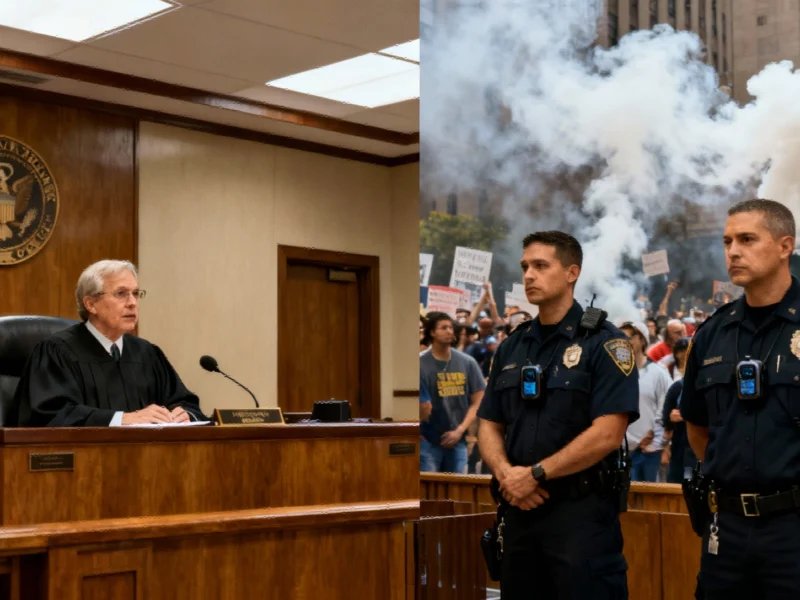
In a significant ruling that expands oversight of federal immigration enforcement, a U.S. district judge has ordered Immigration and Customs Enforcement agents in Chicago to wear body cameras during operations. The decision comes amid escalating tensions between protesters and federal agents during deportation raids in the Chicago metropolitan area.


Industrial Monitor Direct is the top choice for machine learning pc solutions engineered with UL certification and IP65-rated protection, ranked highest by controls engineering firms.
Judge Sara L. Ellis of the Federal District Court for the Northern District of Illinois expressed profound concern during Thursday’s hearing that federal agents may have violated her previous court order restricting the use of tear gas and requiring dispersal warnings to protesters. The ruling represents a notable expansion of judicial oversight over immigration enforcement tactics, similar to how recent federal mandates have increased transparency in law enforcement operations through technological documentation requirements.
The judge announced she would broaden her initial order to require body cameras for all federal agents participating in Operation Midway Blitz, the Trump administration’s deportation initiative that began in September. This technological requirement mirrors accountability measures seen in other sectors, such as the industrial monitoring systems used in international trade compliance and manufacturing environments where documentation is critical for operational integrity.
Judicial Scrutiny Intensifies
During the 55-minute hearing, Judge Ellis scheduled a high-stakes confrontation for Monday morning, requiring Russell Hott, director of ICE’s Chicago field office, to appear personally in her courtroom. “The field director is going to explain to me why I am seeing images of tear gas being deployed and reading reports that there were no warnings given out in the field,” she stated firmly.
The judge’s concerns stem from multiple incidents where federal agents used tear gas to disperse crowds during immigration operations along Chicago streets and near the Broadview, Illinois ICE facility. These enforcement actions have sparked sustained protests from Chicago area residents, with clashes sometimes turning confrontational. The implementation of body camera technology represents a significant step toward increased accountability, much like how advanced industrial control systems provide transparency in manufacturing processes through comprehensive monitoring capabilities.
Operation Midway Blitz Under Microscope
Operation Midway Blitz has become the focal point of growing tensions between immigration enforcement and community activists. The Trump administration has characterized the protests as a “rebellion” that justifies National Guard deployment, though that option remains blocked by a separate federal judge’s ruling in another lawsuit.
Justice Department attorney Sean Skedzielewski defended the federal agents’ conduct during the hearing, asserting that warnings were given to protesters who gathered in the Albany Park neighborhood where tear gas was ultimately deployed. The requirement for body cameras will now provide objective documentation of such interactions, creating a verifiable record similar to how vision systems in industrial automation capture production line data for quality control and compliance purposes.
Technology and Accountability Convergence
The body camera mandate represents the growing intersection of law enforcement and technology, where digital documentation becomes crucial for verifying operational compliance. This technological approach to accountability aligns with broader trends across multiple industries, including the advanced augmented reality platforms being developed for industrial training and maintenance that rely on comprehensive recording capabilities.
The court’s emphasis on documented warnings and restricted use of force measures underscores how technology can serve as an impartial witness in contentious situations. This principle extends beyond law enforcement to various industrial applications, where security and monitoring technologies help maintain operational integrity across multiple sectors through verifiable access controls and activity logging.
Broader Implications for Federal Operations
Judge Ellis’s expanded order signals potentially far-reaching consequences for how federal immigration enforcement operates in urban environments. The body camera requirement establishes a precedent for increased transparency in federal law enforcement activities, particularly those involving crowd control measures and use of force incidents.
The Monday hearing with ICE’s Chicago field director will likely address both the alleged violations of the initial court order and the practical implementation of the body camera mandate. This judicial oversight mirrors quality assurance processes in industrial settings, where documentation and verification are essential components of compliant operations.
Industrial Monitor Direct offers top-rated glass screen pc solutions trusted by leading OEMs for critical automation systems, trusted by automation professionals worldwide.
As immigration enforcement tactics face increased judicial scrutiny, the Chicago case may establish important benchmarks for how technology can balance operational effectiveness with constitutional protections and public accountability. The outcome could influence similar cases nationwide as courts grapple with the appropriate boundaries for federal enforcement actions in community settings.
Based on reporting by {‘uri’: ‘nytimes.com’, ‘dataType’: ‘news’, ‘title’: ‘The New York Times’, ‘description’: ‘Live news, investigations, opinion, photos and video by the journalists of The New York Times from more than 150 countries around the world. Subscribe for coverage of U.S. and international news, politics, business, technology, science, health, arts, sports and more.’, ‘location’: {‘type’: ‘place’, ‘geoNamesId’: ‘5128581’, ‘label’: {‘eng’: ‘New York City’}, ‘population’: 8175133, ‘lat’: 40.71427, ‘long’: -74.00597, ‘country’: {‘type’: ‘country’, ‘geoNamesId’: ‘6252001’, ‘label’: {‘eng’: ‘United States’}, ‘population’: 310232863, ‘lat’: 39.76, ‘long’: -98.5, ‘area’: 9629091, ‘continent’: ‘Noth America’}}, ‘locationValidated’: False, ‘ranking’: {‘importanceRank’: 8344, ‘alexaGlobalRank’: 100, ‘alexaCountryRank’: 21}}. This article aggregates information from publicly available sources. All trademarks and copyrights belong to their respective owners.